The Coding Agent Is Not the Owner
The coding agent can keep moving quickly through ambiguity, so architecture and judgment still have to stay human.

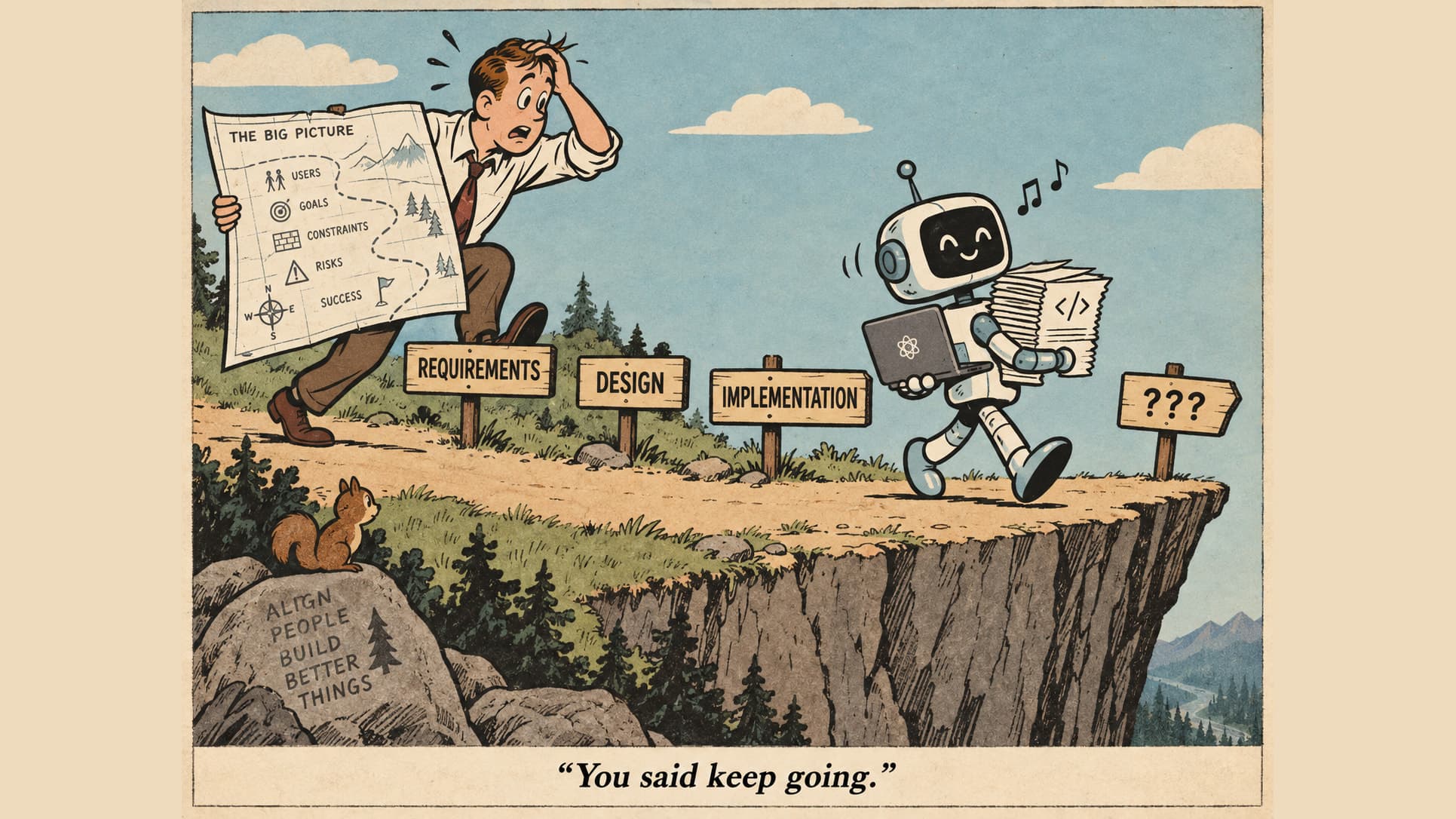
The scariest thing about a coding agent isn't that it might refuse to help. It's that it almost never does. Hand it something ambiguous and it will find a way to keep going.
That's the lesson I keep coming back to from a recent project. We were building a SaaS product, and we used Claude Code all the way through the development process, not in the product itself but in the work of building it. It helped us get from requirements to specs, from design choices to implementation, and from a pile of open questions to code that ran.
What changed was the risk. The question we had to answer wasn't "can the AI behave correctly for the user?" It was "are we disciplined enough to guide the coding agent correctly?"
Movement isn't alignment
A coding agent is very good at creating a sense of progress. You ask for a component, you get a component. It patches a service, generates the tests, and hands you a tidy summary of what it did. The diff shows up, the build passes, the explanation reads well, and everyone on the call sees movement, which is easy to mistake for the work actually being aligned with anything.
The project had a big requirements base spread across a lot of feature areas, requirements that changed late, and a few that showed up after implementation had already started. That's normal. Every real project looks like that. What's new is having a tool in the room that can turn ambiguity into code in about the time it takes to type the prompt.
Ours was a commercial feature whose model moved from usage-based, to tiered, to annual while we were building it. Those aren't three tweaks to the same design. They're three different designs, with different data to track, different limits to enforce, and different answers to what happens when a customer leaves. Each time, the Jira tickets and Confluence pages got updated, product and leadership talked it through, and development was told some version of "the decision is made." So we coded it. Then the decision changed and we recoded it. Then it changed again. The same area of the codebase was rewritten three times, and the customer-exit behavior that depended on it had to track every one of the changes, because it has to work under whichever model is actually live.
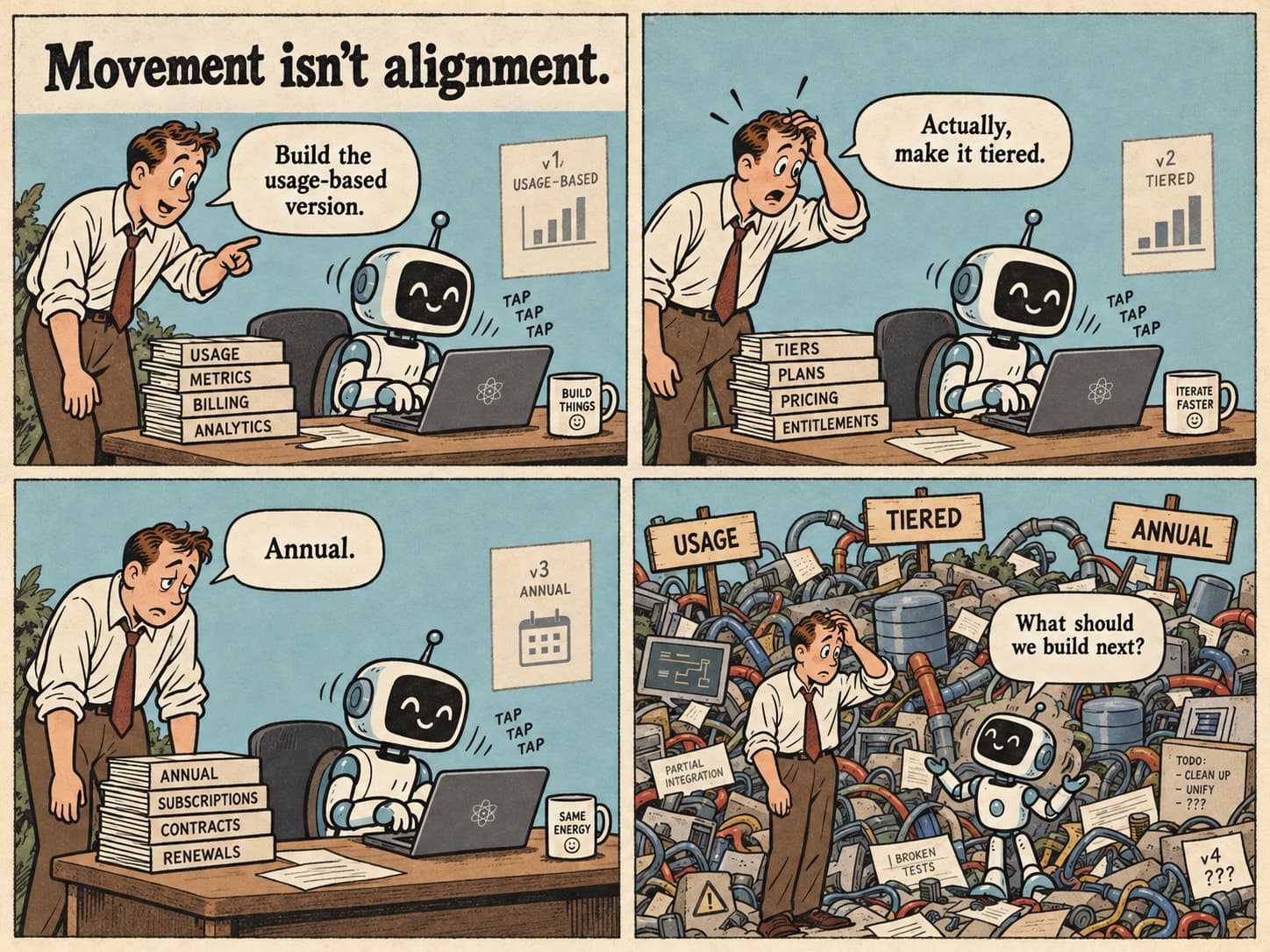
Each cycle left behind real cost: legacy schema, dead code, and tests written for a model that no longer existed. The bigger side effect was less obvious. The leftovers confused Claude Code as much as they confused us. Every time we pointed it at that area, it had three inconsistent patterns and no way to know which one was current, so the tool that helped produce the mess got steadily worse at helping us clean it up. The agent had generated a lot of movement. Very little of it was still aligned with anything.
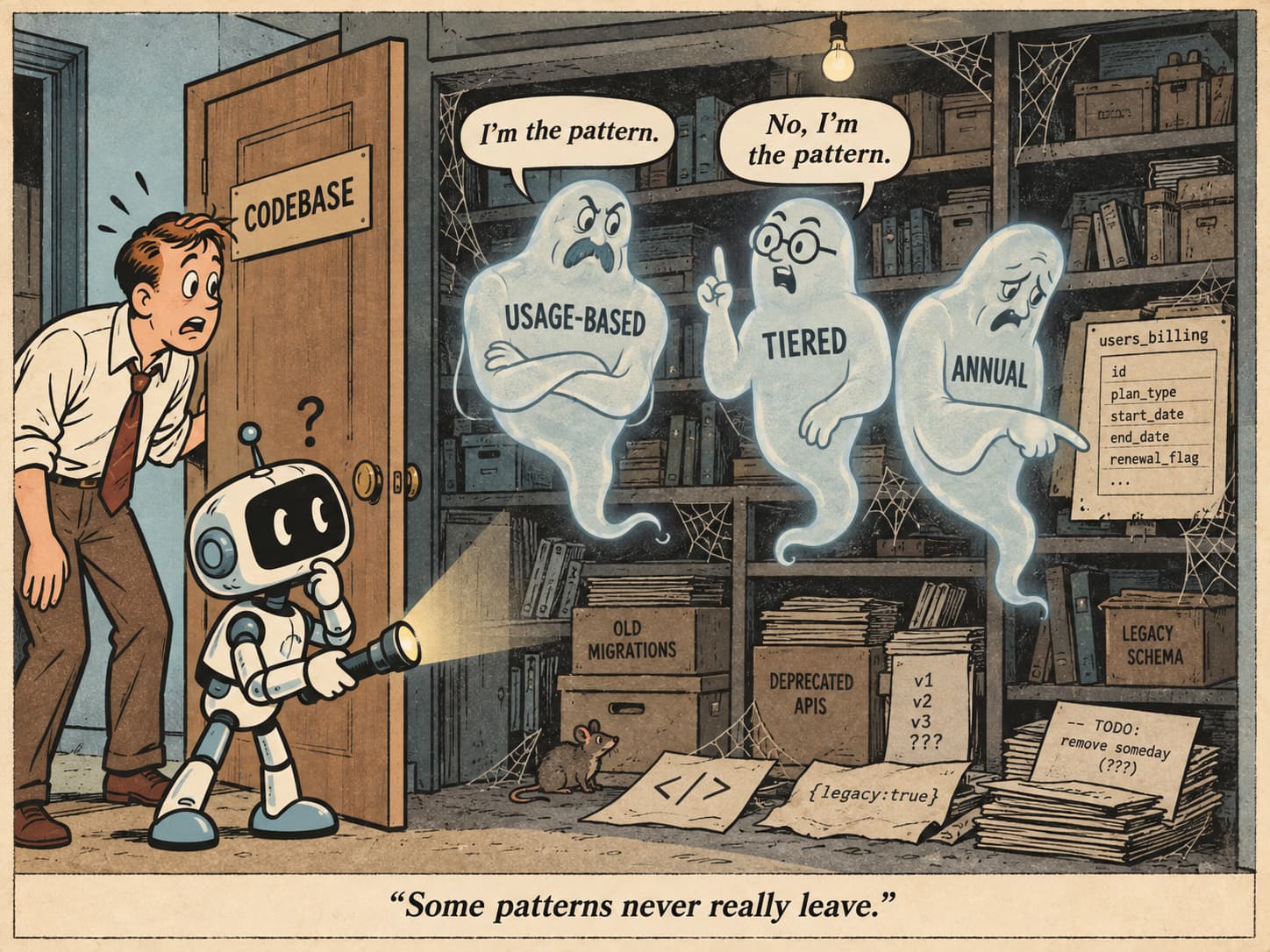
I'd bet most teams using an agent recognize the shape. A requirement appears, someone pastes it in, the agent finds a path, and the output looks reasonable. Nobody stops to ask whether it changed the spec we'd already agreed on, whether the decision behind it was final, or whether scope was accidentally expanded. We skipped the decision and went straight to the prompt.
The agent isn't skeptical for you
Coding agents are sycophantic in practice. I don't mean the model wants to flatter anyone. I mean it is built to be helpful and to finish the task, so it takes the frame you hand it and runs with it. There's a body of research on this under sycophancy in language models: the tendency to reinforce the user's framing instead of pushing back on it.
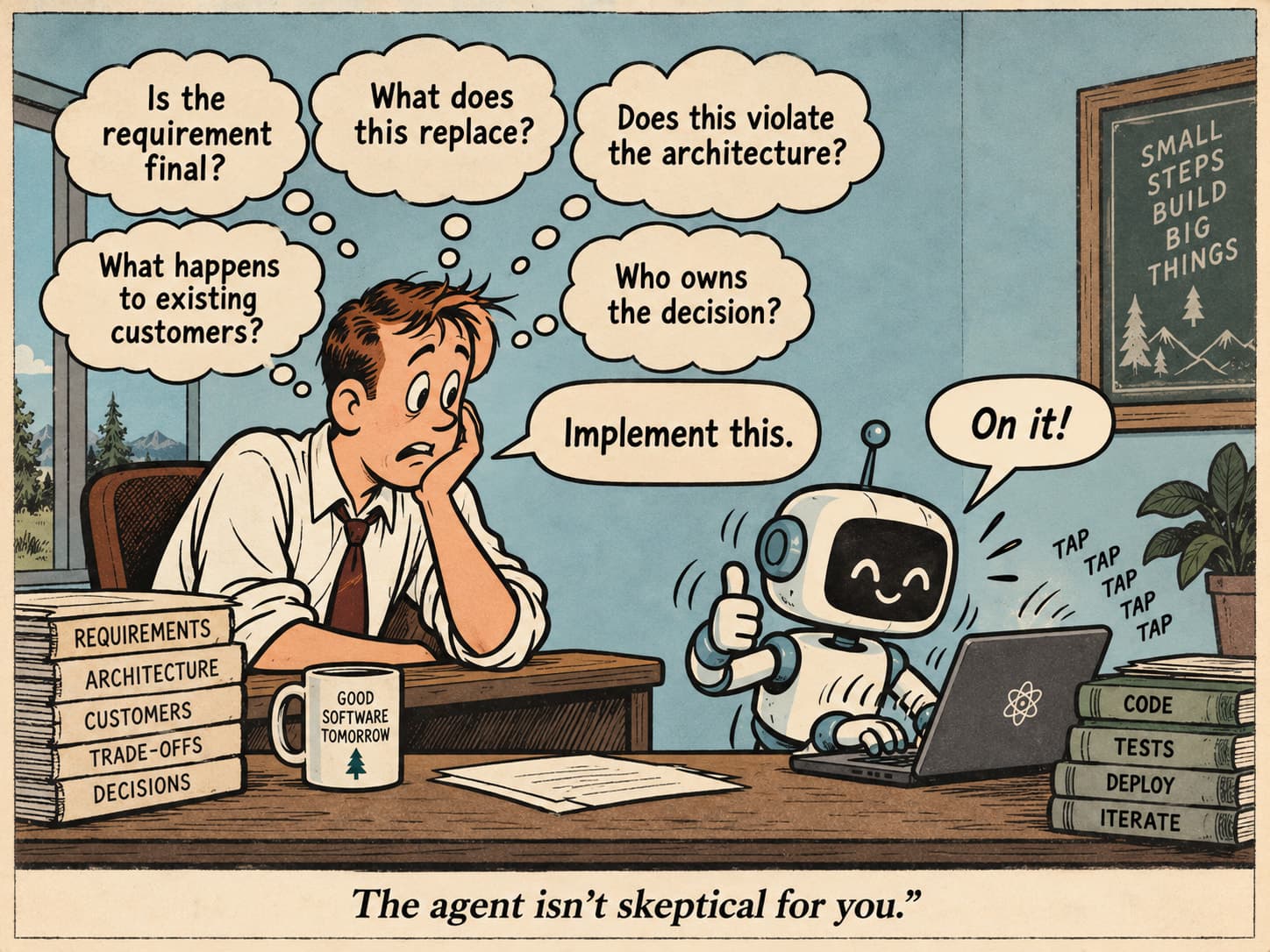
For engineering work the consequence is plain. The agent is not skeptical on your behalf. It can identify risks, compare options, and poke holes in a plan, but only when we give it context and ask. It cannot know which business priority matters this quarter, remember why we made a design call six months ago, or carry the maintenance cost of a shortcut. That part stays with humans.
Ownership, kept practical
This is where I'd reach for extreme ownership, with a caveat. I'm not interested in the phrase as a polite way to tell engineers to absorb chaos. That isn't ownership, that's unmanaged complexity with better branding.
In agent-assisted development, ownership means you don't outsource judgment to a tool that can't own the consequences.
I am documentation-first. I work from the goal backward, I like to keep things simple, and we add complexity when we actually need it. That habit turns out to matter more with a coding agent, not less, because the agent will skip those steps if you let it.
A passive operator hands the agent a broad request and waits. If the code looks clean and tests pass, it moves forward. That works for a contained task. It is not enough when requirements are fuzzy, design is still moving, or a change alters the shape of the application.
An active operator understands the requirement before asking for code. They give context, define constraints, point at the patterns to follow, and mark the boundaries that are not up for negotiation. For anything non-trivial they ask for a plan, argue with it, and then review implementation against requirement and architecture—not just whether it runs.
And they are willing to reject the work. The agent makes acceptance feel cheap because output looks finished. But if an engineer can't explain the code, defend why it belongs in the system, and connect it back to requirement, it is not ready to be accepted no matter how clean the diff is.
Where it bites hardest
Coding agents are strong at local work. They follow nearby patterns, modify files in front of them, and produce reasonable solutions inside a narrow context. Applications rarely fail from one spectacularly poor decision. They fail from many reasonable local decisions that never add up to a coherent system.
So the agent solves the immediate task, and senior engineers still need guardrails before implementation, architectural review, and the willingness to stop changes that solve today at the cost of tomorrow.
Managers are in this too. Claude Code doesn't make unclear requirements free. It doesn't turn late scope into zero-cost scope, and it doesn't remove prioritization work. Faster implementation makes decision discipline more important, because code can now exist before the team has understood the tradeoff.
When a late requirement lands, the team still has to work out what changed, why, whether "the decision is made" means final or just current, what it replaces, what risk is accepted, and who owns the call. Those questions feel like overhead right up until you skip them and watch the agent convert confusion into code.
Once it's merged, it stops being "what Claude Code generated." It's what the team accepted. Other people will maintain it, extend it, debug it, and explain it later. How the code was produced does not reduce our responsibility for what it does.
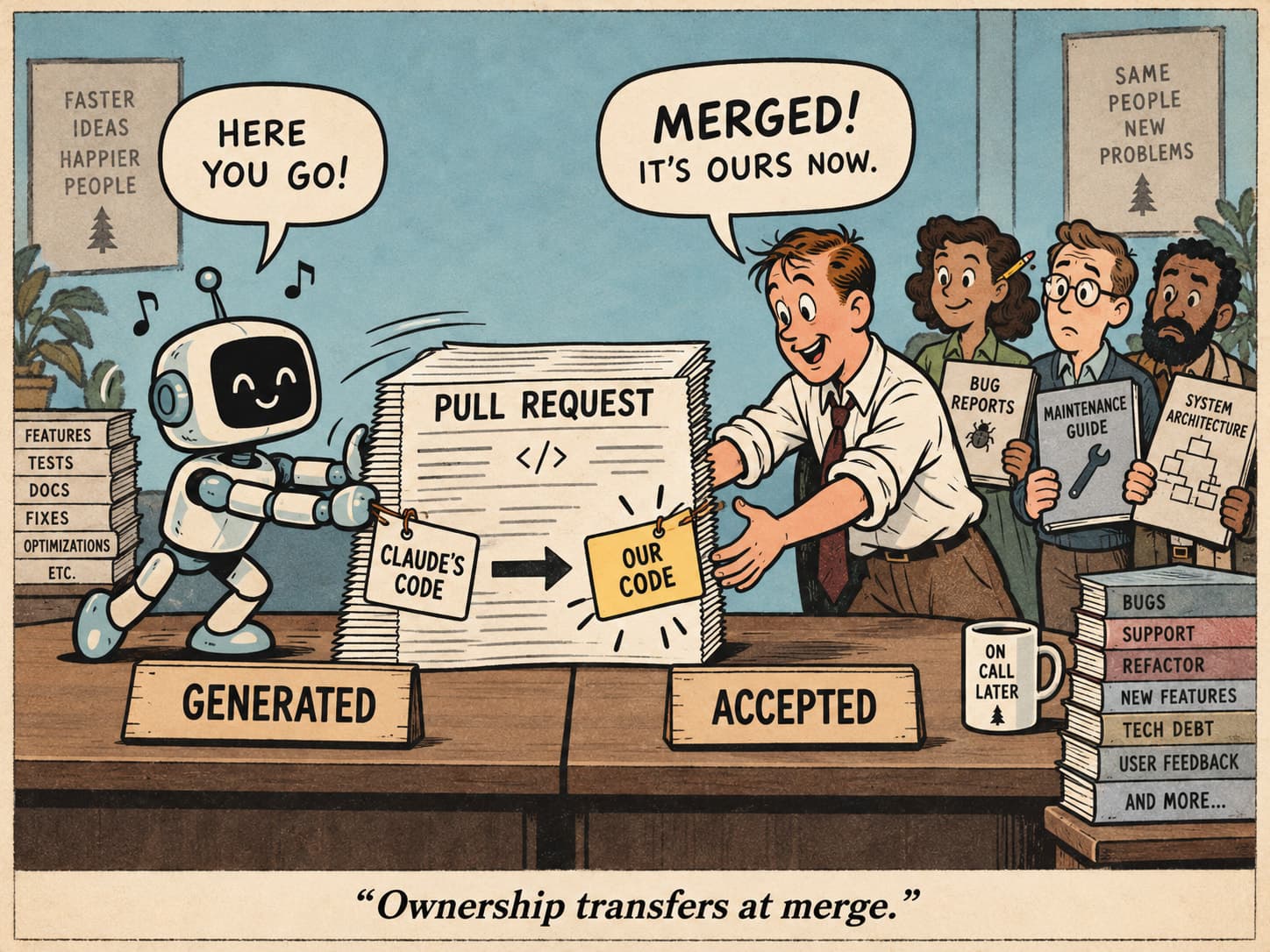
What we actually learned
The project didn't teach us that coding agents are bad. Claude Code gave us real leverage and we moved faster because of it. It also exposed every place our discipline was thin. Getting code to appear was never the hard part. Keeping that code tied to the right requirement, design, and architecture while the project kept shifting was.
The coding agent will keep going. The team has to know where it's going.